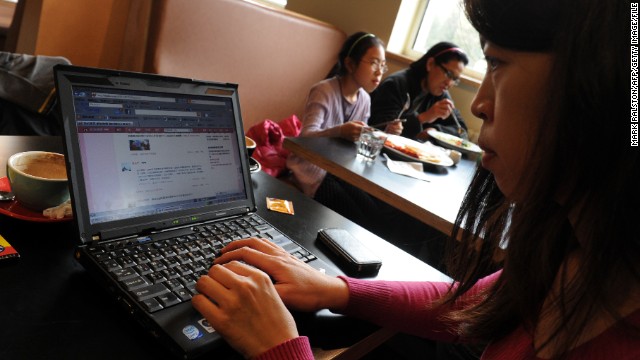
China has around two million people policing
public opinion online, according to a state media report that sheds light on
the country's secretive internet surveillance operations.
Dubbed "public
opinion analysts," they work for the Chinese Communist Party's propaganda
department, major Chinese news websites and commercial corporations, according
to The Beijing News.
Using keyword searches,
their job is to sift the millions of messages being posted on popular social
media and microblogging sites such as Sina Weibo, regarded as China's
equivalent to Twitter. They then compile reports for decision makers, the
report said.
The number of people
monitoring internet activity to prevent criticism of the government and social
unrest has been a subject of discussion for years, said David Bandurski, editor
of the University of Hong Kong's China
Media Project.
"Two
million sounds like a big number," he said. "But I think it's clear
that the government will do what it takes to monitor any potential collective
action on social media."
The
ranks of online censors outnumber China's active armed forces, which total 1.5
million, according to the Ministry of National Defense.
Bandurski
said that the resources China has invested in internet surveillance have
increased rapidly since Sina Weibo's emergence in 2010.
It
now has 500 million account holders although a
recent crackdown on internet rumors has deterred some users.
Posts
run a range of topics from celebrity gossip to politically sensitive issues
like official corruption.
"China's
biggest engineering project is not the Three Gorges dam but public opinion and
Weibo has completely changed the game," Bandurski said.
The
Beijing News described the work of Tang Xiaotao, who has been employed as a
monitor for less than six months by a company that works on government
projects.
Using
a software application that cost $3 million yuan ($490,000), Tang searches for
key words specified by his company's clients, monitors negative opinions and
then compiles a report.
The software also tracks
how widely a topic is being discussed by counting the number of comments and
shares. When the score reaches 40 out of 100, the system will send an alert.
A final decision on what
action to take is decided by the clients, which include government officials,
Tang told the newspaper.
Online analysts like Tang
will be offered specialist training later this month, the newspaper said. The
course, run by the People's Daily online operations, covers judging and
analyzing online posts and dealing with crisis situations.
Those who pass will get a
certificate, formally recognizing them as "public opinion analysts."


No comments:
Post a Comment